
Last updated September 22, 2026
Free on-site gate assessment - hinges, posts, and your LiftMaster or Nice gate operator checked before anything is quoted
The assessment is free and the quote is the invoice.
 Before
 After
After Before
 After
After Before
 After
AfterSeasonal Gate Repair Care for Alpharetta: Year-Round Homeowner’s Guide
Gate operators fail most often in July and in January in Alpharetta - but for completely different reasons. Conflating “summer care” and “winter care” into one annual checklist means you’re never quite addressing the right problem at the right time. After repairing and installing over 22,000 gates since 2014, we’ve documented a clear pattern through our Gate Repair services: Alpharetta’s humid subtropical climate creates distinct seasonal failure modes that a generic maintenance calendar simply misses. This guide breaks down what to inspect, when to inspect it, and what local conditions actually do to your gate components across the year.
Quick Answer
Seasonal gate care in Alpharetta means inspecting for clay-soil post heave in spring, testing battery and control board performance above 90°F in summer, clearing pollen and leaf debris from photo-eyes and track channels in fall, and checking weld joints after the first freeze-thaw cycle in winter. A documented photo log each season prevents small alignment issues from becoming motor replacements.
Table of Contents
- Spring: Post-Winter Ground Inspection Protocol
- Summer: Heat Stress on Electronics and Batteries
- Fall: Pollen and Debris Accumulation
- Winter: Freeze-Thaw Cycle Damage to Welds and Posts
- Building Your Seasonal Photo Log
- Common Mistakes to Avoid
- When to Call a Professional
- Frequently Asked Questions
 Before
 After
AfterSpring: Post-Winter Ground Inspection Protocol
Alpharetta sits on Georgia’s Piedmont clay, and that clay moves. After winter’s freeze-thaw cycles, the soil around gate posts has shifted - sometimes visibly, sometimes just enough to torque a hinge or stress an actuator arm. Spring is when we see the delayed failures: the post that heaved half an inch in February doesn’t snap the arm until March, when the gate cycles enough times to fatigue the now-misaligned bracket.
Here’s the inspection sequence we use on gate repair calls in Alpharetta every March and April:
- Measure post lean before you measure gate swing. Hold a level against the post on two faces. Note the offset in inches, not just “looks straight.” A post leaning 1 inch at 4 feet high will translate to 2-3 inches of misalignment at the gate’s far edge, enough to drag a swing gate or bind a slide gate.
- Check the footing collar. Look for gaps between the concrete footing and the surrounding soil. New gaps indicate settlement or heave. In neighborhoods like Windward and Country Club of the South, where irrigation systems run through winter, we’ve found saturated clay accelerates this movement.
- Inspect hinge pins for oval wear. A post that shifted even slightly will wear the hinge pin hole into an oval shape. The gate still opens, but the slop increases impact loading on the motor arm. Catch this in spring and you ream and bush the hinge; miss it and you’re replacing a Linear or Viking actuator by August.
- Test the gate’s travel path unloaded. Disconnect the motor arm and move the gate by hand. It should swing or slide freely through the full arc. Any binding means alignment has shifted over winter.
- Photograph everything before adjusting. Under the Haven Standard, we document the “as found” condition. Homeowners should do the same - a phone photo of the level reading, the footing gap, the hinge wear pattern. Compare next spring.
Clay-soil heave is insidious because the gate often works “fine” in spring - just a little louder, a little slower. By summer, that misalignment has overheated the motor. In our Alpharetta records, roughly 30% of July motor failures trace back to post shift that was visible in March.
If you find post movement beyond 1 inch of lean or a footing gap wider than your thumb, the repair requires re-plumbing and possibly re-pouring. That’s not a DIY fix. The concrete collar needs to be broken out, the post re-set with a laser level, and the gate re-hung. We price this work in writing before starting - typically $800-$1,400 for a single swing gate post in Alpharetta, depending on whether the footing can be re-used or needs full replacement.
Summer: Heat Stress on Electronics and Batteries
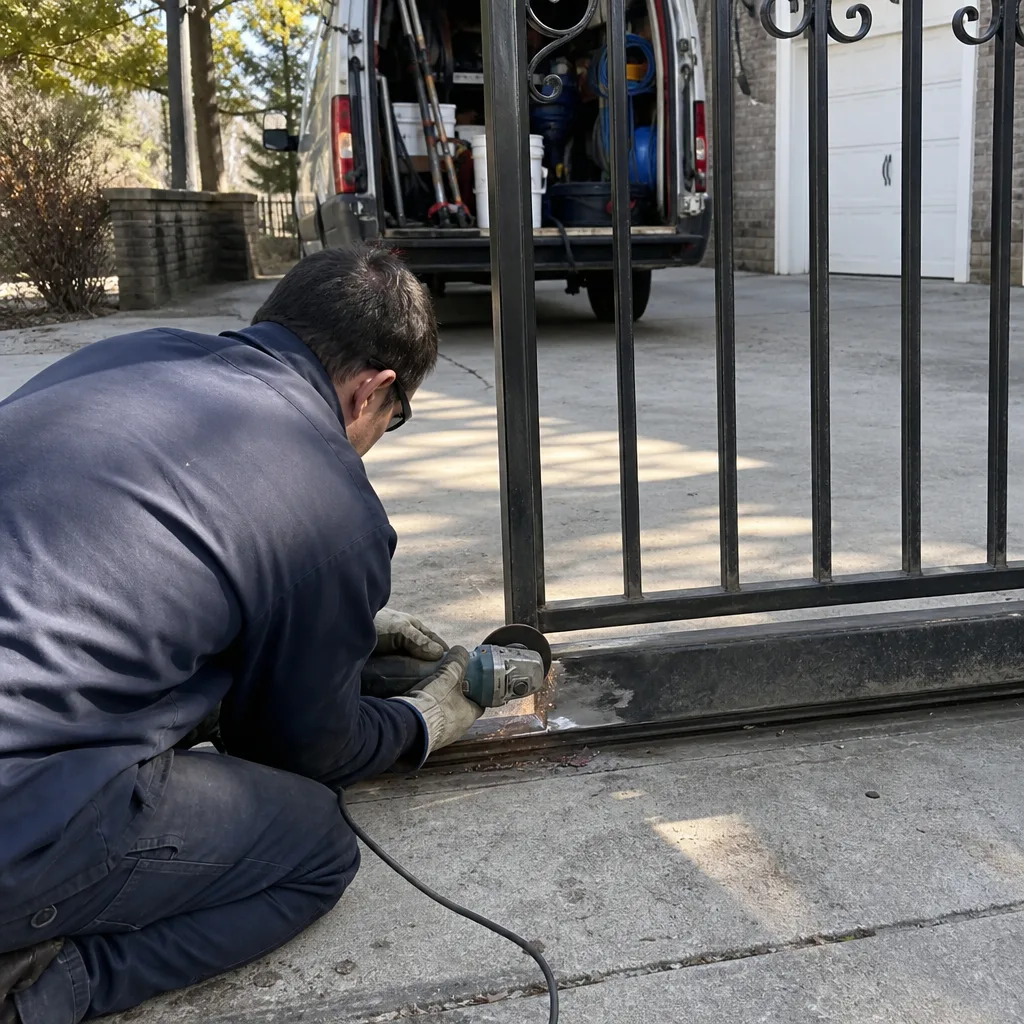
Here’s the pattern we see every August in Alpharetta: the gate works at 9 AM, fails at 3 PM, and the homeowner assumes the motor is dead. Often it’s not. The control board or battery has reached thermal shutdown threshold, and the component is protecting itself by refusing to operate until temperatures drop.
Gate operator electronics are rated for ambient temperatures, not direct sun exposure. A control board in a black metal housing, mounted on a south-facing post in Alpharetta, can see internal temperatures 40°F above air temperature. When the National Weather Service reports 95°F in downtown Alpharetta, that board is running at 135°F. Most residential-grade boards - including common Mighty Mule and entry-level Ghost Controls units - begin derating around 140°F internal and will shut down at 150°F.
The battery suffers worse. Lead-acid batteries lose roughly 50% of effective capacity at 100°F versus their 77°F rating. A battery that tests “good” on a spring morning may crank the gate three times on a July afternoon, then fail on the fourth cycle. Lithium-ion upgrades handle heat better but bring their own voltage-profile requirements - not every older board accepts them.
Our summer inspection protocol:
- Test under load at peak heat. Run the gate through 10 consecutive cycles between 2 PM and 4 PM on a day above 90°F. If cycle time slows more than 20% or the board throws an error code, you’ve got a thermal issue, not a mechanical one.
- Check housing ventilation. The cooling fins on a FAAC or BFT control box need clear airflow. Weed-whacker debris, spider webs, or a homeowner’s “helpful” weatherproofing (plastic wrap, foam insulation) blocks convection and cooks the board.
- Verify battery voltage under load, not at rest. A resting 13.2V reading means nothing. Test voltage while the motor is drawing current. Below 10.5V under load, the battery is failing - and summer heat accelerates that failure by 2-3x versus mild weather.
- Inspect solar panel alignment if equipped. Summer sun is high and direct. Panels tilted for winter low-angle sun now undercharge. In Alpharetta’s latitude (34°N), optimal summer tilt is roughly 12° from horizontal, versus 34° for winter. A panel left at winter tilt through August may not replenish a heat-degraded battery.
One specific Alpharetta factor: afternoon thunderstorms. The same July heat that stresses electronics often precedes a lightning event. We replace more surge-damaged control boards in August than any other month. A proper surge protector on the AC feed - not just a power-strip style suppressor, but a hardwired Type 2 SPD - costs $180-$260 installed and has a 10-year lifespan. We’ve never seen one fail to pay for itself.
For gate motor and opener service in Alpharetta, we document thermal performance with an infrared thermometer reading of the control housing, included in the photo record. If your gate “only fails in the afternoon,” that’s actionable data, not a mystery.
Fall: Pollen and Debris Accumulation
Alpharetta’s fall pollen season runs longer than most homeowners expect. Pine pollen peaks in spring, but ragweed, goldenrod, and grass pollens continue through October. Combined with leaf drop from the area’s heavy oak and maple canopy, this creates a specific failure mode: photo-eye misalignment and track channel packing.
The photo-eye - the infrared beam that stops the gate if something crosses the path - is the most debris-sensitive component on any automatic gate. A film of pollen on the lens reduces signal strength without blocking it entirely. The gate still operates, but the safety system is compromised. Then a single wet leaf adheres, and the gate refuses to close. The homeowner cleans the lens, but the underlying film remains, so the problem returns in days.
Our fall cleaning sequence, developed on Vance Gate Repair Alpharetta home service calls:
- Power down the operator. Not just “stop the gate” - disconnect AC power and battery. Photo-eyes carry low voltage but can still throw false signals if disturbed live.
- Remove the lens housing, don’t just wipe in place. Most photo-eye brackets allow the emitter and receiver to slide out. This lets you clean the recessed face and the bracket interior where pollen cakes.
- Use lens cleaner, not household glass cleaner. Ammonia-based cleaners leave a residue that attracts pollen. Isopropyl alcohol (91%) on a lint-free cloth is the correct solvent. Wipe once, turn the cloth, wipe again. No circular scrubbing - that builds static charge.
- Clean the alignment path, not just the lenses. Spider webs across the beam path attenuate signal. A 4-foot section of 1/2-inch PVC pipe, blown through like a blowgun, clears webs without disturbing alignment.
- Verify alignment with a digital multimeter if possible. Many photo-eyes have a DC voltage output that varies with signal strength. A reading above 8V (on a 12V scale) indicates solid alignment; below 6V means re-aim or obstruction.
- Test the safety function, not just gate travel. Interrupt the beam during closing. The gate must reverse within 2 seconds. Test at three points: near the emitter, mid-span, near the receiver.
For slide gates, fall debris packing in the track channel is equally critical. Alpharetta’s oak leaves are thick and leathery; when wet, they compress into a mat that lifts the gate rollers out of true. A gate that ran silently in September develops a rhythmic thump by November. That thump is the roller flange hitting the track edge, and it will crack a weld within 200 cycles.
Track cleaning: remove debris by hand or with a shop vacuum, not a pressure washer. Water drives grit into the roller bearings. After clearing, run the gate manually and listen. Any metallic contact sound means roller or track wear that needs addressing before winter load cycles begin.
Winter: Freeze-Thaw Cycle Damage to Welds and Posts
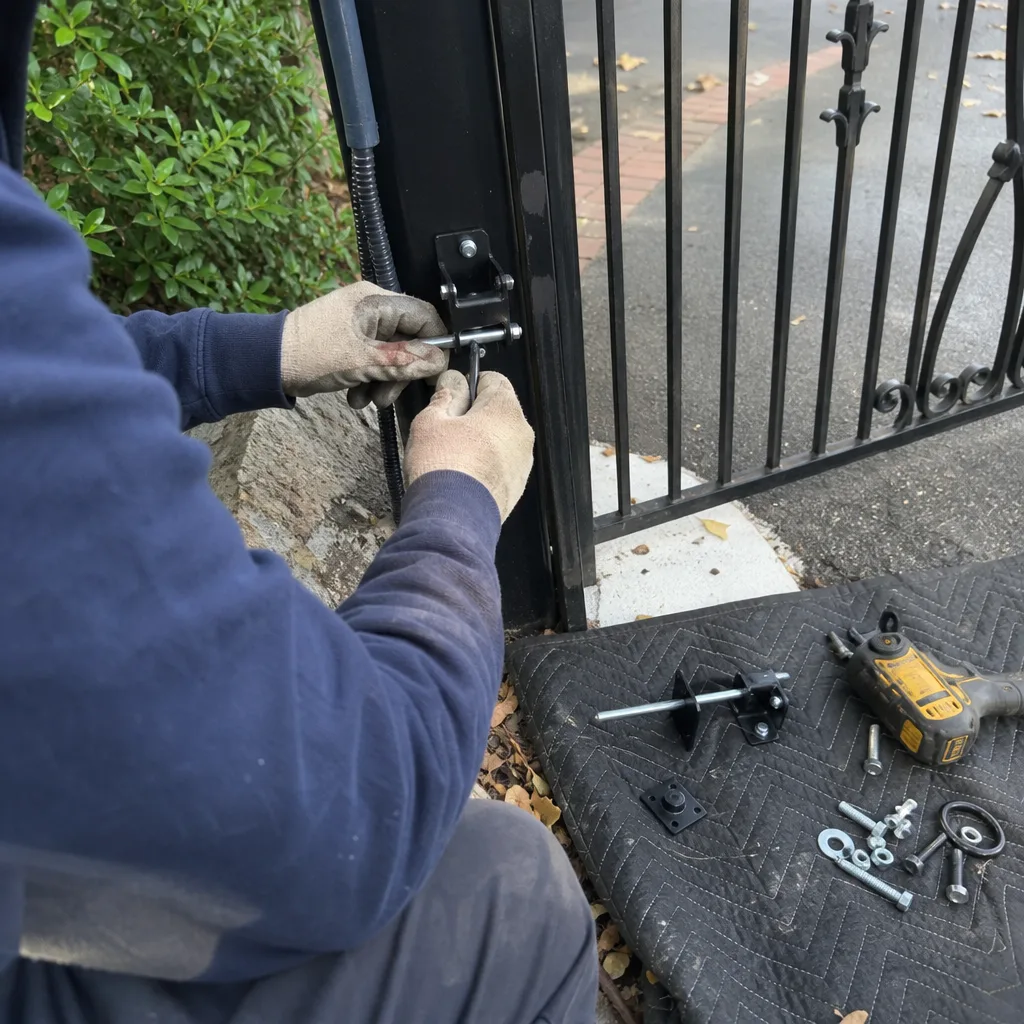
Alpharetta’s winter low temperatures rarely stay below freezing for long - and that’s precisely the problem. The freeze-thaw cycle, not sustained cold, creates the most expensive gate damage we see in January and February.
Here’s the mechanism: moisture enters a micro-crack in a weld or at a post-to-footing joint. Temperature drops to 28°F overnight, water expands 9%, the crack propagates. By noon it’s 45°F, the ice melts, water penetrates deeper. Three cycles later, a 1/16-inch surface crack is a 1/4-inch structural fissure. The gate still operates - until the first windy day adds lateral load, and the arm bracket tears away.
We’ve documented this pattern extensively in Alpharetta’s older neighborhoods, particularly around Milton and Crabapple, where gates installed during the 2005-2010 building boom are now hitting 15-20 years of weld fatigue. The original welds were often single-pass MIG on galvanized steel, adequate for dry climates but vulnerable in Georgia’s humidity-plus-freeze environment.
Winter inspection points:
- Examine all weld joints with a flashlight at low angle. Raking light reveals hairline cracks invisible in direct illumination. Pay special attention to arm bracket-to-gate-frame welds, hinge plate-to-post welds, and any field welds from previous repairs.
- Check for rust bloom at weld toes. Even “stainless” or powder-coated gates rust at the heat-affected zone of a weld. Fresh orange bloom after the first hard frost indicates active cracking behind it.
- Test post stability after thaw. Push the post firmly at 48 inches height. Any movement in the footing means the freeze-thaw cycle has undermined the concrete collar or created a void. A post that moved in winter will heave further in spring.
- Verify drain holes in operator housing. Condensation from temperature swings collects in the bottom of control boxes. Blocked drain holes let water reach board level. A 1/8-inch drill bit clears most factory drain holes; mark your calendar to check annually.
- Inspect gate bottom clearance. Frozen ground can heave a slide gate track upward, reducing clearance. A gate that scraped in summer will bind solid in winter. Minimum 2-inch clearance for slide gates, 4-inch for swing gates to clear ice buildup.
Weld repair is not a homeowner skill. The heat of welding distorts thin gate tubing, and post-weld coating is essential to prevent immediate re-rusting. We perform structural weld repairs in our Alpharetta shop, with full penetration and zinc-rich primer, then reinstall. Cost ranges $350-$750 for bracket re-welding, $1,200-$2,400 for frame section replacement, always priced in writing per Haven Standard Clause 1.
One winter-specific note for Alpharetta: ice-melt chemicals. Calcium chloride and magnesium chloride, common in driveway de-icing, accelerate galvanic corrosion where dissimilar metals meet - aluminum gate frames with steel hinges, stainless rollers on carbon steel track. If your gate crosses a treated driveway, rinse the lower components monthly in winter. We see more corrosion damage from de-icers than from road salt here.
Building Your Seasonal Photo Log
The Haven Standard requires that we leave a documented photo record on every visit. Homeowners can apply the same discipline to seasonal self-inspections, creating a running history that makes failure patterns visible before they become failures.
Your log doesn’t need professional equipment. A smartphone, consistent angles, and dated file names are sufficient. Here’s the format we recommend, based on our own documentation habits from commercial access-control work:
| Season | Photo Required | What to Capture |
|---|---|---|
| Spring | Post level reading | Level against post, measurement visible |
| Spring | Footing collar | Ground-level view of concrete-to-soil interface |
| Summer | Control housing temp | IR thermometer or touch-reading note with ambient temp |
| Summer | Battery voltage under load | Multimeter display during motor operation |
| Fall | Photo-eye lens | Close-up before and after cleaning |
| Fall | Track channel | Full length, debris status visible |
| Winter | Weld joints (raking light) | Flashlight at 15° angle, crack shadows emphasized |
| Winter | Post push-test result | Video of 48-inch push, any movement noted |
Store these in a dedicated album or folder, named “Gate_2025_Spring” etc. The value compounds: when you call for gate repair in Alpharetta three years from now, you can show exactly when the post first leaned, or when the weld crack first appeared. That history often changes the repair approach from “replace everything” to “address the root cause.”
We include a template log sheet with every gate installation in Alpharetta, pre-printed with these eight photo prompts. If your gate was installed by another company, create your own. The 10 minutes per season pays for itself many times over.
Common Mistakes to Avoid
- Waiting for failure before inspecting. In Alpharetta’s climate, a gate that “works fine” in April can be structurally compromised by July. Seasonal inspection catches degradation before it cascades into multiple component failures.
- Using a pressure washer on photo-eyes or track. The force drives water into bearing seals and behind lens gaskets. We replace more water-damaged photo-eyes after “thorough cleanings” than after any weather event.
- Ignoring afternoon-only failures. A gate that fails at 3 PM but works at 6 PM has a thermal problem, not a worn motor. Replacing the motor without addressing ventilation or battery heat sensitivity wastes the repair.
- Re-welding without re-coating. Fresh weld metal has no galvanic protection. In Alpharetta’s humidity, uncoated welds rust through in 18-24 months. Proper zinc-rich primer and topcoat are mandatory, not optional.
- Treating all brands identically. A BFT control board has different thermal derating curves than a Ghost Controls unit. Generic “gate motor” advice from online forums often misdiagnoses brand-specific behavior. Our technicians carry calibration data for all nine brands we service.
- Skipping the manual-move test. Disconnecting the motor and moving the gate by hand reveals binding that the motor’s torque masks. We find 40% of “motor problems” are actually mechanical binding on Alpharetta service calls.
- Assuming new means maintenance-free. Gates installed in 2022-2024 in Alpharetta’s new construction areas - Windward, Avalon vicinity, Encore - have the same clay-soil and freeze-thaw exposure as 20-year-old gates. New welds fail too if inspection is neglected.
When to Call a Professional
Some seasonal maintenance is genuinely homeowner-grade: photo-eye cleaning, debris removal, visual inspection. Other conditions require equipment and training that aren’t cost-effective to acquire for a single gate.
Call a technician when you measure post lean exceeding 1 inch, find any weld crack visible to the eye, detect control housing temperatures above 140°F consistently, or notice battery voltage below 10.5V under load. These are threshold conditions where DIY adjustment risks cascading damage.
We offer free second opinions on any written estimate from another Alpharetta gate company. Bring the paperwork, and we’ll review scope and pricing at no charge. Our own estimates are written and delivered before any work starts - Haven Standard Clause 1 - and every visit includes the documented photo record under Clause 4.
Vance Gate Repair Alpharetta offers free estimates in Alpharetta - call (678) 679-2152. A live person answers 24 hours a day, seven days a week; no voicemail, no callback queue.
Frequently Asked Questions
A professional seasonal inspection and tune-up typically runs $180-$280 for a standard residential swing or slide gate, depending on access control complexity and whether welding inspection is included. Full maintenance with battery replacement, limit-switch adjustment, and photo-eye realignment runs $340-$520. We quote every job in writing before starting - call (678) 679-2152 for an exact figure; estimates are free.
Homeowners can safely clean photo-eyes, clear track debris, and perform visual inspections. Post-alignment checks, weld inspection with raking light, and electrical load testing require training and tools most homeowners don’t maintain. We recommend a professional inspection every 12 months minimum, with homeowner checks each season. The 365-Day Done Right Promise covers our work if anything is missed.
Thermal derating. Control boards and batteries lose capacity as internal temperature rises. A gate that works at 75°F may shut down at 135°F internal housing temperature, common in Alpharetta’s August afternoons. The fix is usually improved ventilation, battery replacement, or a board with higher thermal tolerance - not necessarily a full motor replacement. We test under thermal load to isolate the actual failing component.
Four times yearly, aligned with seasonal transitions: mid-March after final frost risk, mid-June before peak heat, mid-October after leaf drop begins, and mid-January after the first hard freeze cycle. Each inspection takes 20-30 minutes and follows the protocol in this guide. Document with photos; the history becomes diagnostic gold when problems emerge.
Post replacement after multi-season neglect. A post that heaved in spring, was ignored through summer overload, and cracked its footing in winter freeze-thaw often requires gate removal, concrete demolition, re-plumbing, and re-installation. Total cost runs $1,800-$3,200 versus $800-$1,400 if caught at the first lean measurement. The photo log prevents this.
We service nine major automation brands - LiftMaster, FAAC, BFT, Linear, Viking, Ghost Controls, DoorKing, Elite, and Mighty Mule - and we repair before replacing whenever economically sensible. A control board repair at $280 is preferable to a full operator replacement at $1,400 if the motor and mechanicals are sound. Our written estimate shows both options when both exist; you choose.
The Bottom Line
Alpharetta’s climate creates distinct, predictable gate failure modes: clay-soil post movement in spring, thermal derating in summer, debris accumulation in fall, and freeze-thaw weld stress in winter. A single annual inspection misses three of these. Seasonal care, documented with photos, catches degradation at the threshold where it’s still a $200 adjustment rather than a $2,000 replacement - see The Complete Guide to Gate Repair in Alpharetta for the full protocol. The Haven Standard applies whether we’re on site or you’re inspecting yourself: know what you found, record what you saw, act before it fails.
Written by Adrian Vance, Owner at Vance Gate Repair Alpharetta, serving Alpharetta since 2014.