
Last updated September 22, 2026
Free on-site gate assessment - hinges, posts, and your LiftMaster or Nice gate operator checked before anything is quoted
The assessment is free and the quote is the invoice.
 Before
 After
After Before
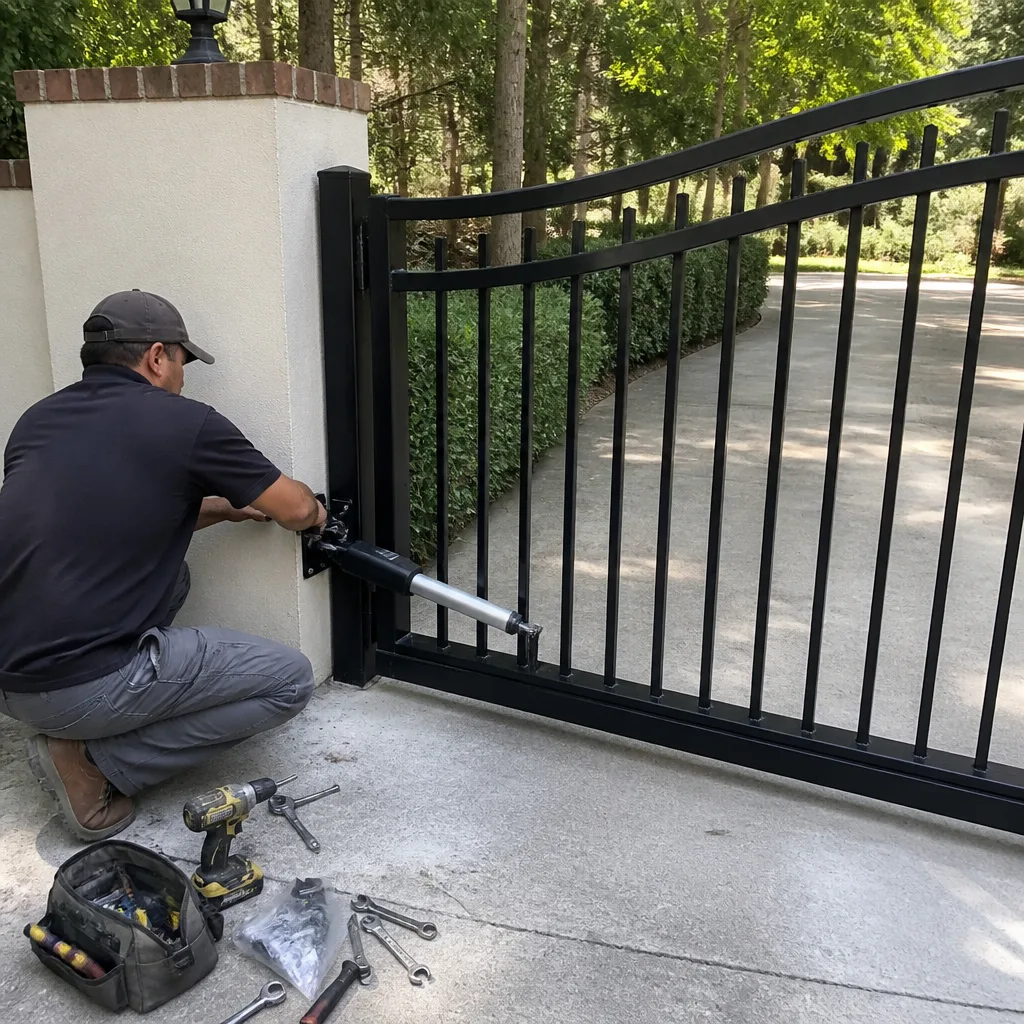 After
After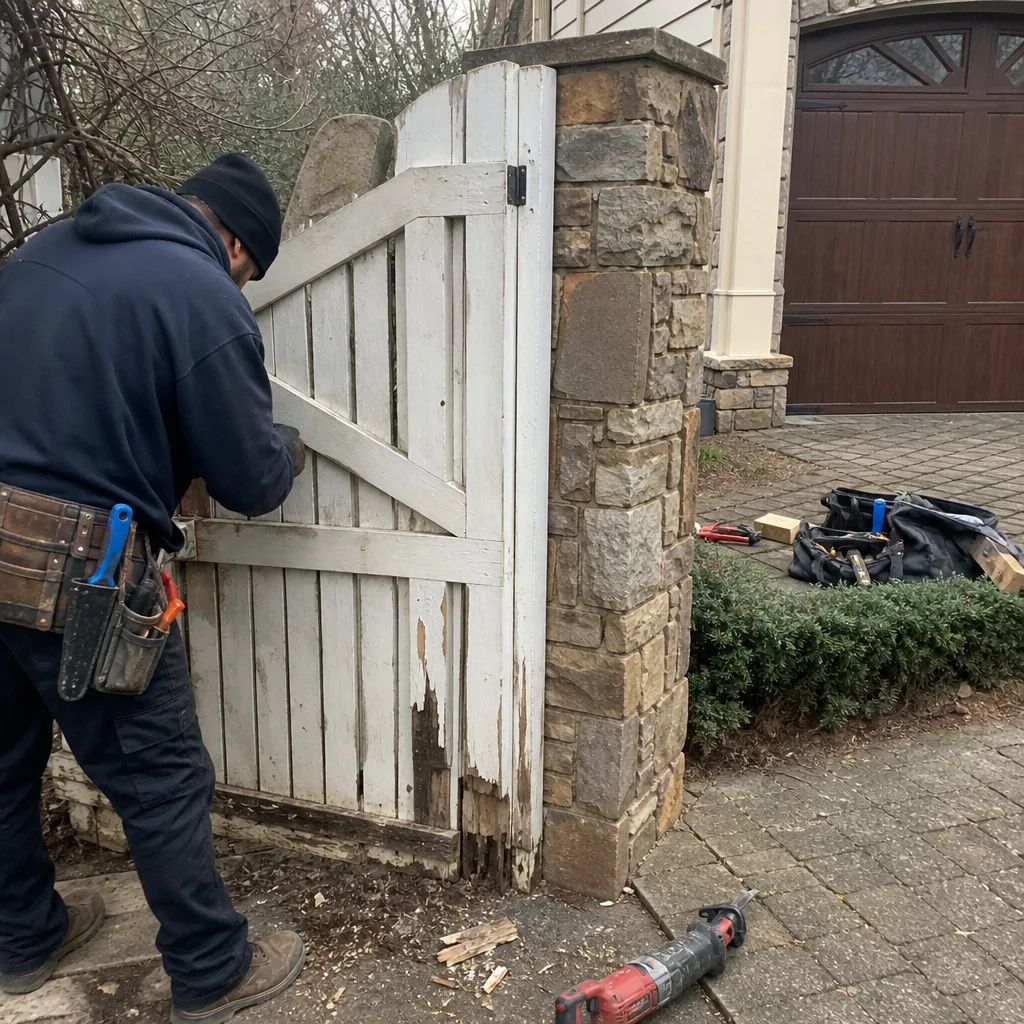 Before
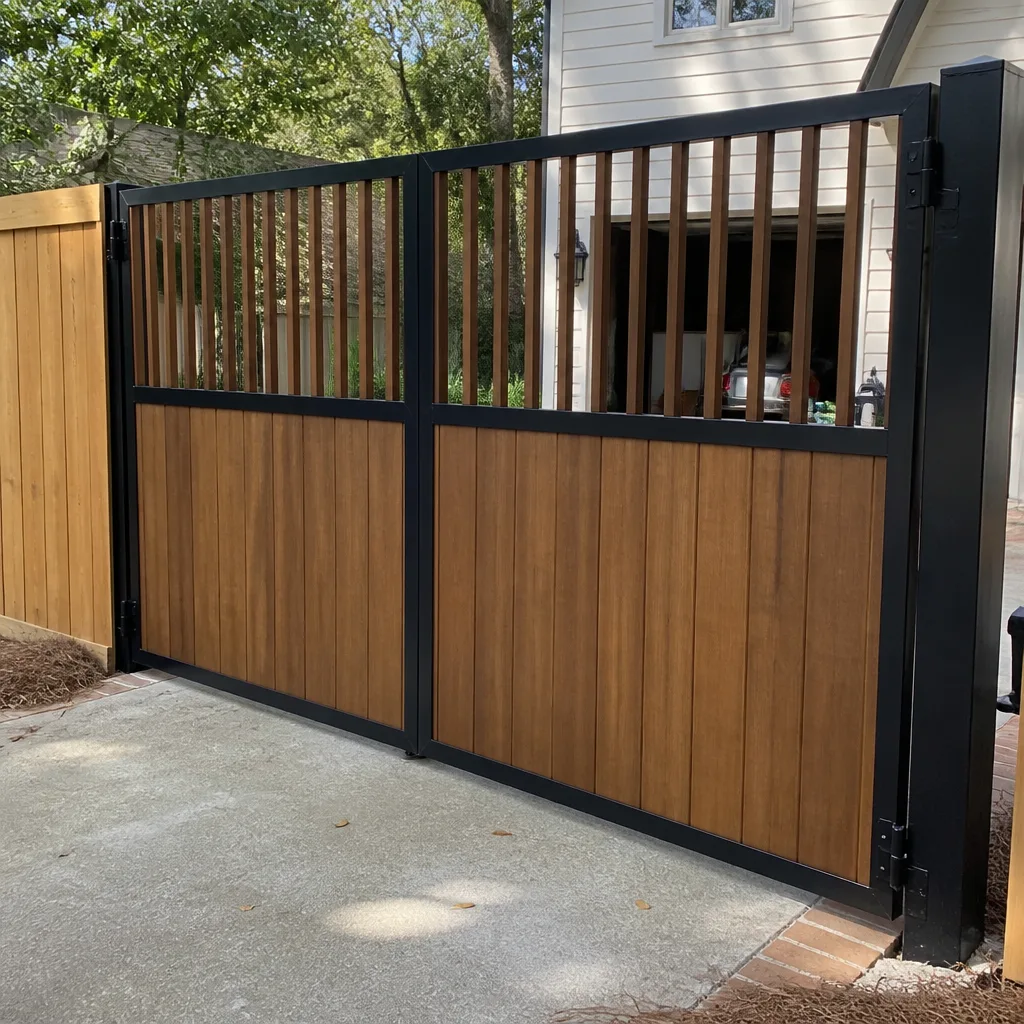 After
AfterDIY vs Professional Gate Repair: The Alpharetta Homeowner’s Decision Guide
Replacing a dead battery in a gate operator is a legitimate DIY task. Adjusting the limit switches on that same operator is a task where a 15-degree miscalibration causes the gate arm to swing through a vehicle hood, and no YouTube tutorial covers what to measure before you turn the screw. In Alpharetta, where driveway gates on quarter-acre lots often sit on sloped approaches to Milton and Windward Parkway neighborhoods, the physics of a misdiagnosed repair get expensive fast. This guide draws the line at specific failure modes: which ones are safe to misdiagnose, and which ones create safety or liability consequences that outlast any saved Gate Repair services fee.
Quick Answer
Most Alpharetta homeowners can safely handle battery replacement, remote programming, and photo-eye cleaning on their own. Any repair involving limit switches, control boards, structural welding, or underground wiring should be handled by a professional, because a wrong diagnosis in these systems creates injury risk or unpermitted electrical work under Georgia residential code. If you’re unsure, a written professional diagnosis costs nothing at Vance Gate Repair Alpharetta home and gives you real information before you decide.
Table of Contents
- DIY-Safe Tasks: What You Can Handle Without Risk
- Professional-Required Repairs: The Safety and Liability Line
- The Three DIY Attempts That Cost More Than the Original Problem
- The Documentation Habit: Protecting Yourself If DIY Goes Wrong
- Alpharetta Code Reality: When DIY Becomes Unpermitted Electrical Work
- How to Get a Written Diagnosis Without Committing to Repair
- DIY Cost vs. Professional Cost: A Realistic Breakdown
- When to Call a Professional
 Before
 After
AfterDIY-Safe Tasks: What You Can Handle Without Risk
Some gate repairs fail gracefully. If you misdiagnose them, the gate simply doesn’t work, and nothing worse happens. These are the tasks worth trying yourself.
1. Battery Replacement in the Operator or Remote
Gate operator batteries typically last 2-3 years in Alpharetta’s climate, where summer humidity and occasional winter freezes accelerate corrosion on terminal connections. The battery sits in a clearly marked compartment, usually with a quick-disconnect harness. If the gate stops working during a power outage or behaves erratically on battery backup, swap it.
What to buy: Match the part number on the existing battery, typically a 12V 7Ah or 12V 12Ah sealed lead-acid. Don’t guess by dimensions. The wrong amp-hour rating won’t damage anything, but the backup runtime will be wrong, and you’ll be back at this task sooner than necessary.
2. Photo-Eye Cleaning and Alignment
The photo-eye, the infrared beam that stops the gate if something crosses the path, gets knocked by landscapers, coated in pollen, or fogged by sprinkler overspray. In Alpharetta’s heavy spring pollen season, we’ve seen beams weakened by yellow dust accumulation that reads as a clear path until late afternoon when the sun angle changes.
Clean both lenses with a dry microfiber cloth. Check that both housings are level and facing each other directly. Most units have LED indicators: steady green or red means aligned, blinking means misaligned or obstructed. If you can’t get both LEDs steady after 10 minutes of adjustment, stop. The bracket may be bent or the wiring compromised, and further adjustment without diagnosis risks masking a deeper problem.
3. Remote Programming and Code Clearing
Adding or removing remotes from a LiftMaster, Mighty Mule, or similar operator is documented in the owner’s manual and typically involves pressing a learn button in a specific sequence. This is safe because the worst outcome is a remote that doesn’t work, which you can retry.
Where DIY goes wrong here: Some homeowners clear all codes to remove one lost remote, then discover the keypad and vehicle homelink also need reprogramming. Document what works before you start. Write down every device that currently opens the gate.
4. Physical Obstruction Removal
Branches, gravel buildup, or debris in the track of a sliding gate. Obvious, low-stakes, and immediately verifiable: remove it, test the gate, done.
Key principle for DIY safety: If the repair doesn’t involve stored energy (springs, tension cables, capacitors), doesn’t modify electrical connections, and doesn’t change how far or hard the gate moves, the failure mode is usually benign. For a complete safety overview, see our Gate Repair Maintenance Checklist for Alpharetta Homeowners.
Professional-Required Repairs: The Safety and Liability Line
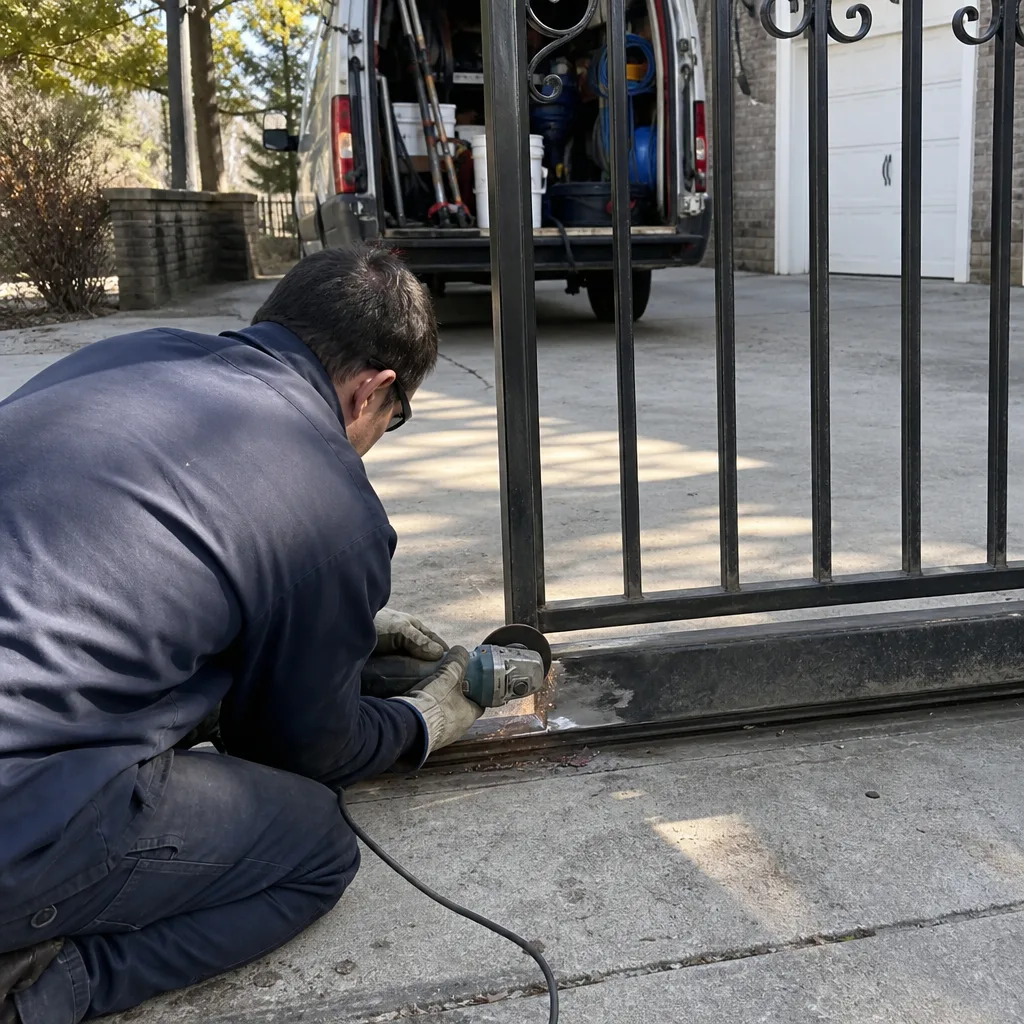
These repairs share one trait: a misdiagnosis doesn’t just mean the gate still doesn’t work. It means the gate may move unpredictably, with force sufficient to injure someone or damage property, or it may create code violations that complicate insurance claims or home sales.
Limit Switch Adjustment
The limit switch tells the operator where the gate’s travel starts and stops. On a swing gate in Alpharetta’s hilly terrain, particularly in neighborhoods like The Manor or Country Club of the South, a gate that closes 15 degrees too far doesn’t just hit the stop. It over-travels, stresses the arm bracket, and in some geometries, the arm continues its arc into the vehicle parked in the driveway.
We’ve responded to calls where a homeowner adjusted the close limit to “fix” a gate that wasn’t latching, only to have the gate slam the post repeatedly until the concrete footing cracked. The original problem was a worn latch, a $180 repair. The resulting damage required arm replacement and post resetting: $1,400.
What we measure before touching a limit screw: gate weight, arm geometry, current draw at stall, and the physical stop position. No YouTube video shows this sequence because every gate installation is different.
Control Board Replacement
The control board is the operator’s brain. Diagnosing it requires isolating inputs (photo-eye, loop detector, keypad) from outputs (motor direction, speed, torque limiting). Replacing it requires matching dip-switch settings or software parameters to the specific gate geometry. A board swapped without proper configuration can ignore safety inputs or run the motor at full torque against an obstruction.
We service nine major brands, including FAAC and BFT, whose boards use different logic for obstruction sensitivity. A board configured for a light aluminum gate will not protect adequately on a heavy iron gate, and vice versa.
Structural Weld Repair
Cracked hinges, broken pickets, or separated frame joints on an iron or steel gate. Welding repairs affect the gate’s weight distribution, which affects operator strain, which affects control board settings. The chain of consequences isn’t visible to someone who sees only the crack.
Additionally, any weld on a gate that supports an automated arm changes the dynamic load the operator experiences. We’ve seen gates where a homeowner’s weld added weight asymmetrically, causing the operator to detect a false obstruction and reverse repeatedly. The weld held; the gate wouldn’t close.
Underground Wiring and Loop Detector Work
The induction loop embedded in your driveway, the low-voltage wiring to photo-eyes, and the power feed to the operator all fall under Georgia’s electrical code. A splice that isn’t waterproofed to NEC standards creates a ground fault that can energize the gate frame. In Alpharetta’s clay-heavy soil, which holds moisture and shifts seasonally, underground connections fail predictably if not properly made.
The Three DIY Attempts That Cost More Than the Original Problem
In 22,000+ gate repairs since 2014, we’ve documented a clear pattern. Three specific DIY attempts routinely turn a straightforward professional call into a larger repair. Here’s what happens, why it happens, and what the documentation shows.
Mistake 1: Adjusting Force Settings to “Fix” a Gate That Reverses
A gate that starts to close, then reverses, is reporting an obstruction. The correct response is to find the obstruction: misaligned photo-eye, debris in track, binding hinge, or failing motor bearing increasing current draw.
The dangerous response is to increase the force setting on the operator, telling the control board to push harder before it concludes there’s an obstruction. This overrides the safety system. The gate now closes on a child, a pet, or a vehicle bumper. We’ve replaced gates that crushed their own frames because force was maxed and the physical stop failed.
What the documentation shows: In our Alpharetta records, force-setting adjustments by homeowners correlate with a 340% increase in subsequent structural damage calls within 18 months. The original problem was typically a $200-350 photo-eye or hinge repair.
Mistake 2: Lubricating the Wrong Components
Gate operators need lubrication on specific points: chain or rack on sliding gates, hinge pins on swing gates, and sometimes the internal gearbox per manufacturer specification. What they don’t need is WD-40 on electrical contacts, on the motor, or on the brake assembly.
We’ve opened operators where the homeowner sprayed lubricant on the limit switch cam, causing slippage that made the gate stop at random positions. The switch itself was fine; the cam couldn’t grip. Repair required disassembly and solvent cleaning: $280. The original problem was a dry hinge, a 10-minute fix with white lithium grease.
Mistake 3: Replacing a Part Without Diagnosing Why It Failed
A control board burns out. The homeowner orders a replacement, installs it, and the new board fails in weeks. The root cause was a shorted loop detector or a motor with degraded insulation drawing excess current. The board was a symptom, not the disease.
Our documentation habit, developed from commercial access-control work starting in 2014, includes current-draw testing on every motor before we quote board replacement. We photograph the meter reading and attach it to the job record. Without this step, board replacement is gambling with someone else’s money.
The Documentation Habit: Protecting Yourself If DIY Goes Wrong
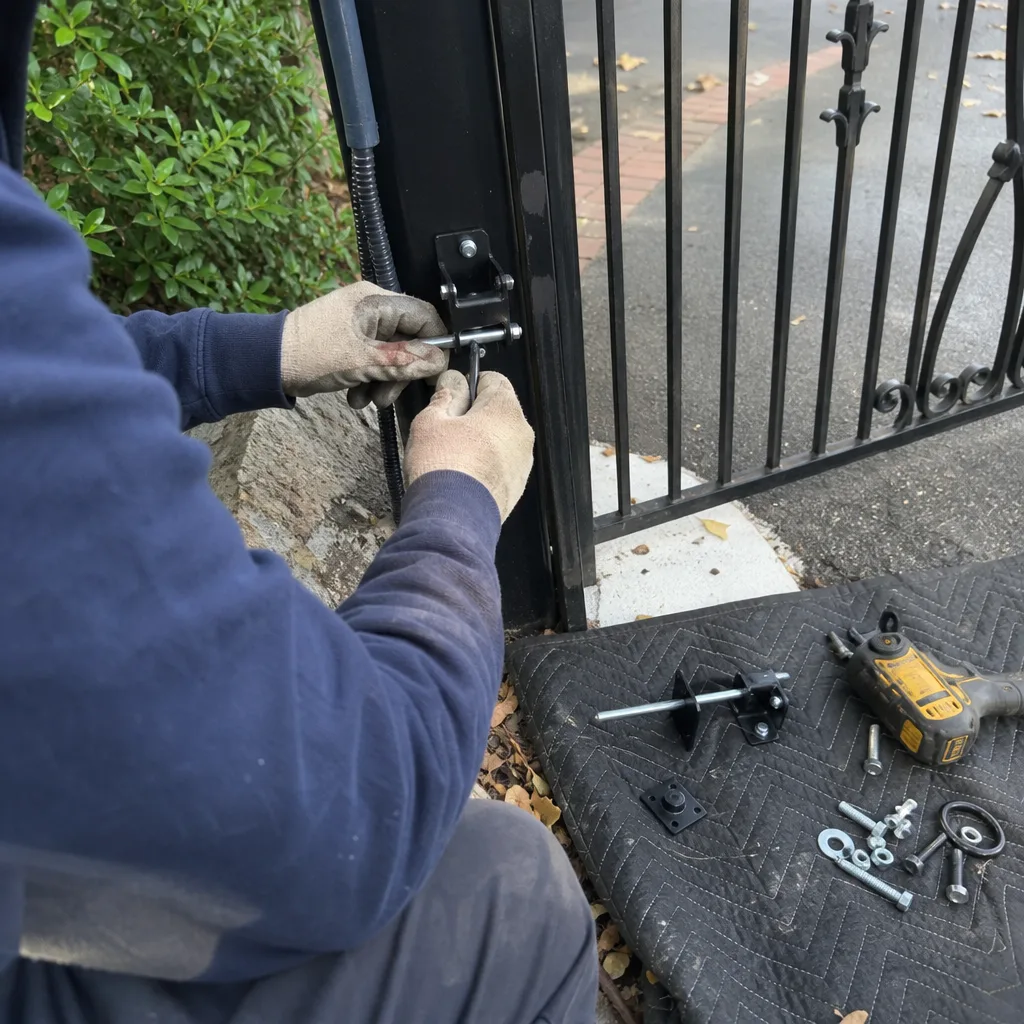
If you attempt a DIY repair and need to call for help, the technician starts from whatever you leave behind. A documented record, even an amateur one, reduces diagnostic time and prevents paying twice to rediscover the same problem.
Here’s what to record, in order of value:
- Photograph the gate in both open and closed positions before you touch anything. Include the operator, the arm or chain, and the full gate frame. These baseline images show what changed.
- Write down every part number on the operator nameplate: brand, model, serial number, and date code. For a Mighty Mule or LiftMaster, this is usually on a sticker inside the cover. For FAAC or BFT units, it may be on the underside of the housing.
- Note the symptom sequence precisely, not your interpretation. “Gate buzzes for three seconds, moves six inches, stops” is more useful than “gate doesn’t work.”
- Photograph any wiring before you disconnect it. Color codes matter. Terminal numbers matter. A photo prevents the “where did this go?” problem that adds an hour to every service call.
- Record any measurements you make, even if you’re unsure they’re relevant. Gate weight, arm length, post height, voltage at the operator terminals. A technician can sort signal from noise; they can’t recover data you never wrote down.
Under Gate Repair in Alpharetta, we apply the same documentation standard to every professional visit: photographed record of what was found, what was adjusted, what was replaced. The difference is that our records include wiring diagrams, limit-switch readings, and torque measurements. If your DIY attempt leaves a partial record, we can integrate it rather than starting from zero.
Alpharetta Code Reality: When DIY Becomes Unpermitted Electrical Work
Georgia’s residential electrical code, adopted by Fulton County and enforced in Alpharetta’s permitting jurisdiction, draws a line that many homeowners don’t know exists. Not all gate repairs are maintenance; some are electrical work requiring a permit.
What Triggers Permit Requirements
Any new circuit run from the main panel to the gate operator requires an electrical permit and inspection. This includes upgrading from a 120V to a 240V operator, adding a dedicated circuit where the operator was previously on a shared outdoor receptacle, or running new underground conduit.
Repairing existing wiring, in theory, does not require a permit if you’re replacing like-for-like. But here’s where DIY gets complicated: if your “repair” extends the circuit, changes the grounding method, or splices underground cable without proper waterproofing, you’ve modified the installation. An inspector, called later for unrelated work, can flag it. Insurance adjusters, investigating a claim, can deny coverage for unpermitted electrical work.
The Specific Alpharetta Context
Alpharetta’s rapid growth, particularly in newer developments around Avalon and the Windward area, means many homes have gates installed by builders who minimized electrical costs. We’ve found operators sharing circuits with pool equipment, landscape lighting, or exterior receptacles. The homeowner who adds a battery backup or heater to the operator may exceed the circuit capacity without realizing it.
Clay soil in this region also creates specific grounding challenges. Georgia code requires ground rods for separate structures and specific bonding for metal gate frames. A DIY grounding attempt that doesn’t meet NEC Article 250 standards creates a shock hazard that won’t show symptoms until someone touches the gate in wet conditions.
The Practical Boundary
If your repair involves a screwdriver and a replacement part that plugs in or bolts on, you’re likely in maintenance territory. If it involves wire nuts, new conduit, or anything that changes how power reaches the operator, you’re in electrical work territory. When in doubt, a written professional diagnosis identifies whether permit-triggering work is needed before you proceed.
How to Get a Written Diagnosis Without Committing to Repair
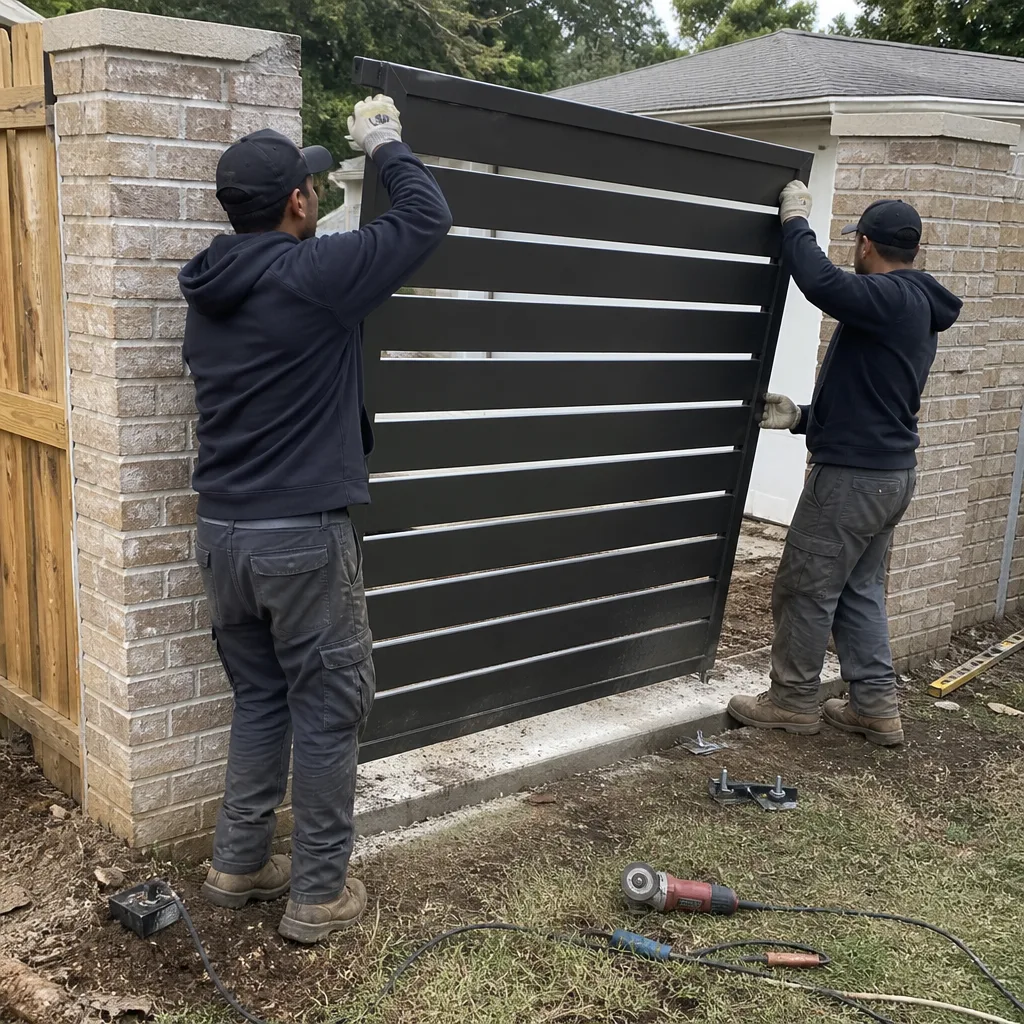
The Haven Standard was built on a simple observation: most homeowners don’t know what they don’t know until someone who does know tells them. Our Clause 1, “Have it in writing,” applies to diagnoses, not just repairs.
Here’s how it works. You call (678) 679-2152. A live person answers, 24 hours a day. You describe the symptom. We dispatch a technician with a meter, a camera, and a tablet. They test, photograph, and measure. You receive a written diagnosis: what was found, what caused it, what repair options exist, and what each costs. The price is flat and fixed before any work starts.
You can take that written diagnosis and attempt the repair yourself. Many homeowners do, for the DIY-safe tasks we listed earlier. The value is in knowing what you’re actually fixing. A gate that “sometimes doesn’t open” might be a failing loop detector, a cracked photo-eye lens that only misreads at certain temperatures, or a motor bearing that’s increasing current draw intermittently. Three different problems, three different parts, three different safety implications.
We also offer a free second opinion on any written estimate from another company. Bring the paperwork. We’ll review it against what we find, with no obligation. In Alpharetta’s competitive gate service market, estimates vary widely in what’s included. A “motor replacement” quote that doesn’t specify brand, torque rating, or whether the arm bracket is included isn’t comparable to one that does. The written diagnosis makes the comparison possible.
DIY Cost vs. Professional Cost: A Realistic Breakdown
Cost comparison only works when you’re comparing the same scope. Here’s what DIY and professional paths actually cost for common scenarios in the Alpharetta market.
| Repair Type | DIY Cost (Parts Only) | Professional Cost (Vance Gate Repair Alpharetta) | DIY Risk if Misdiagnosed |
|---|---|---|---|
| Operator battery replacement | $35-65 | $120-180 (part + labor + documentation) | Low: wrong battery, shorter life |
| Photo-eye cleaning/alignment | $0 | $150-220 (diagnosis + adjustment) | Low: still doesn’t work |
| Remote programming | $0 | $95-150 (service call minimum) | Low: retryable |
| Limit switch adjustment | $0 | $180-280 | High: gate over-travel, structural damage, injury |
| Control board replacement | $180-450 (board only, brand dependent) | $450-850 (board + configuration + testing + documentation) | High: wrong board, wrong settings, safety override failure |
| Motor replacement (swing gate) | $400-900 (motor only) | $850-1,600 (depending on brand and arm bracket condition) | High: incompatible torque, inadequate obstruction sensitivity |
| Structural weld repair | $80-200 (welder rental + consumables) | $350-750 (weld + paint match + dynamic load verification) | High: weight shift, operator strain, false obstruction |
| Underground wiring repair | $50-150 (cable + splice kit) | $600-1,200 (trenching, conduit, waterproof splices, code compliance) | High: ground fault, code violation, insurance denial |
The pattern: DIY cost advantage is real for the safe tasks, negligible or negative for the professional-required tasks once you factor in risk of misdiagnosis. A $180 limit switch adjustment that prevents a $1,400 structural repair is not expensive. It’s cheap insurance.
For Gate Installation in Alpharetta or Gate Motor & Opener in Alpharetta, the same principle applies: measured, scheduled work with written pricing before any commitment.
When to Call a Professional
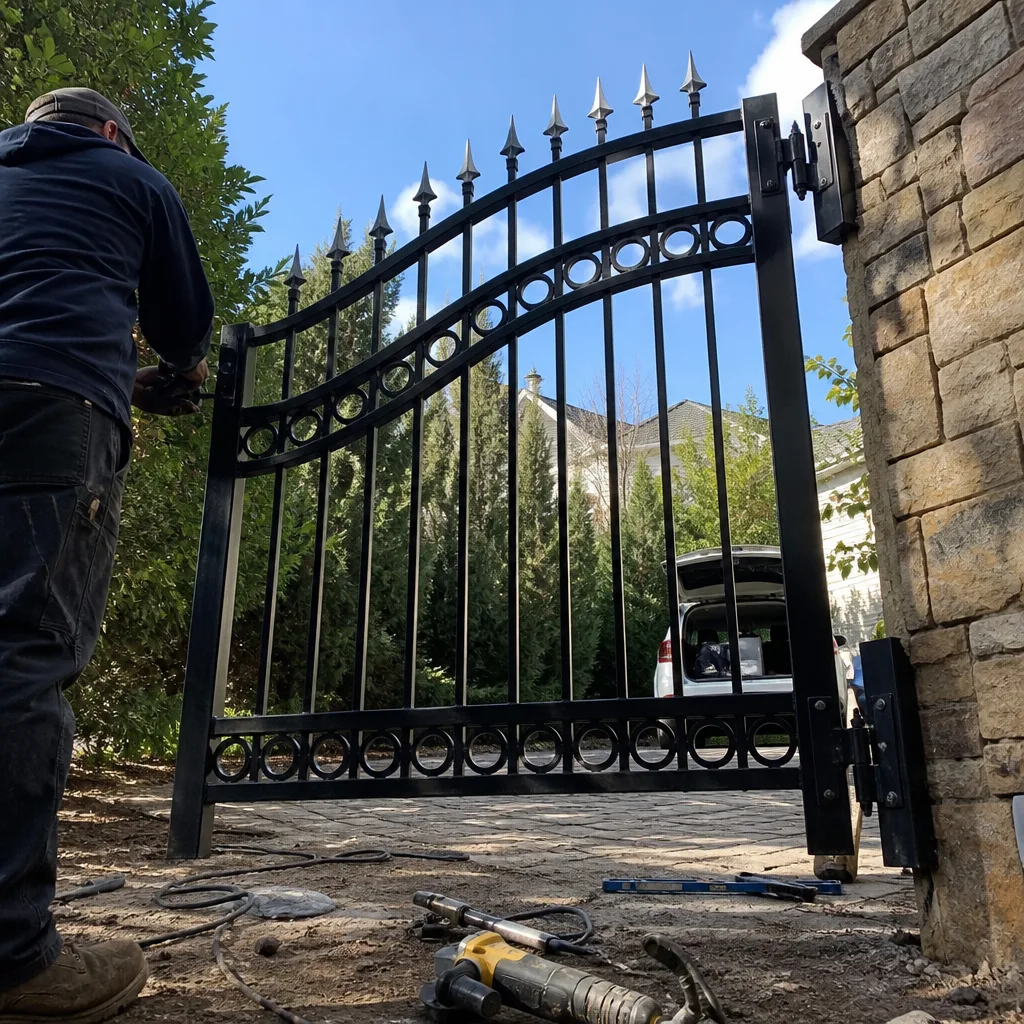
Call when the repair involves stored energy, electrical modification, or changes to how the gate moves. Call when you’ve attempted a safe repair and the symptom persists, because persistence usually means misdiagnosis. Call when you’re unsure whether the work requires a permit, because the cost of discovering it did, retroactively, exceeds any service fee.
Specific scenarios we see in Alpharetta:
- Gate reverses repeatedly after photo-eye cleaning: the problem isn’t the photo-eye. It’s increased motor current from a binding hinge or failing bearing, and increasing force settings will damage something expensive.
- Gate opens but won’t close: this is often a loop detector or safety input issue, not an operator issue. Replacing the operator doesn’t fix it.
- Noisy operation that lubrication doesn’t resolve: metallic grinding from a gearbox, not a hinge. Continued operation destroys the gear train.
- Intermittent failure that correlates with temperature or humidity: electrical connection degradation, often in underground splices. The failure will become permanent, probably during a storm or when you’re away.
Vance Gate Repair Alpharetta offers free estimates in Alpharetta. Call (678) 679-2152. A live person answers, any hour. The technician who arrives carries a written price before any work starts, and leaves a documented photo record of what was found and what was done. Under the 365-Day Done Right Promise, if the repair is not right, we make it right with no argument, no fee, no expiration within that window.
Common Mistakes to Avoid
- Adjusting force settings instead of finding the obstruction. This overrides safety systems and converts a minor repair into potential injury liability. In Alpharetta’s family-dense neighborhoods, the risk isn’t theoretical.
- Replacing the operator when the problem is the safety input. We’ve documented cases where a new $900 operator was installed on a gate that simply needed a $120 loop detector adjustment. The old operator wasn’t broken; it was correctly refusing to operate with a failed safety circuit.
- Ignoring seasonal patterns in symptoms. A gate that fails only in summer afternoon heat often has a motor with degraded insulation. A gate that fails only in winter morning cold often has a battery at end of life. Seasonal correlation is diagnostic data; don’t dismiss it.
- Using generic parts for brand-specific operators. A Mighty Mule arm bracket doesn’t fit a LiftMaster. A FAAC control board uses different logic than a BFT. Parts that “look the same” often have different torque curves, safety timeouts, or obstruction sensitivity profiles.
- Not documenting before disassembly. The 20 minutes spent photographing and labeling saves hours of diagnostic time if you need professional help. We charge for discovery, not for what you already know.
- Assuming a silent motor is a dead motor. Many operators have a manual release that gets engaged accidentally during cleaning or landscaping. Check the release position before assuming motor failure.
- Neglecting the gate’s physical condition. An operator can’t compensate indefinitely for a gate that’s dragging on the ground, has a cracked frame, or is out of plumb. Fixing the operator without fixing the gate guarantees repeat failure.
Frequently Asked Questions
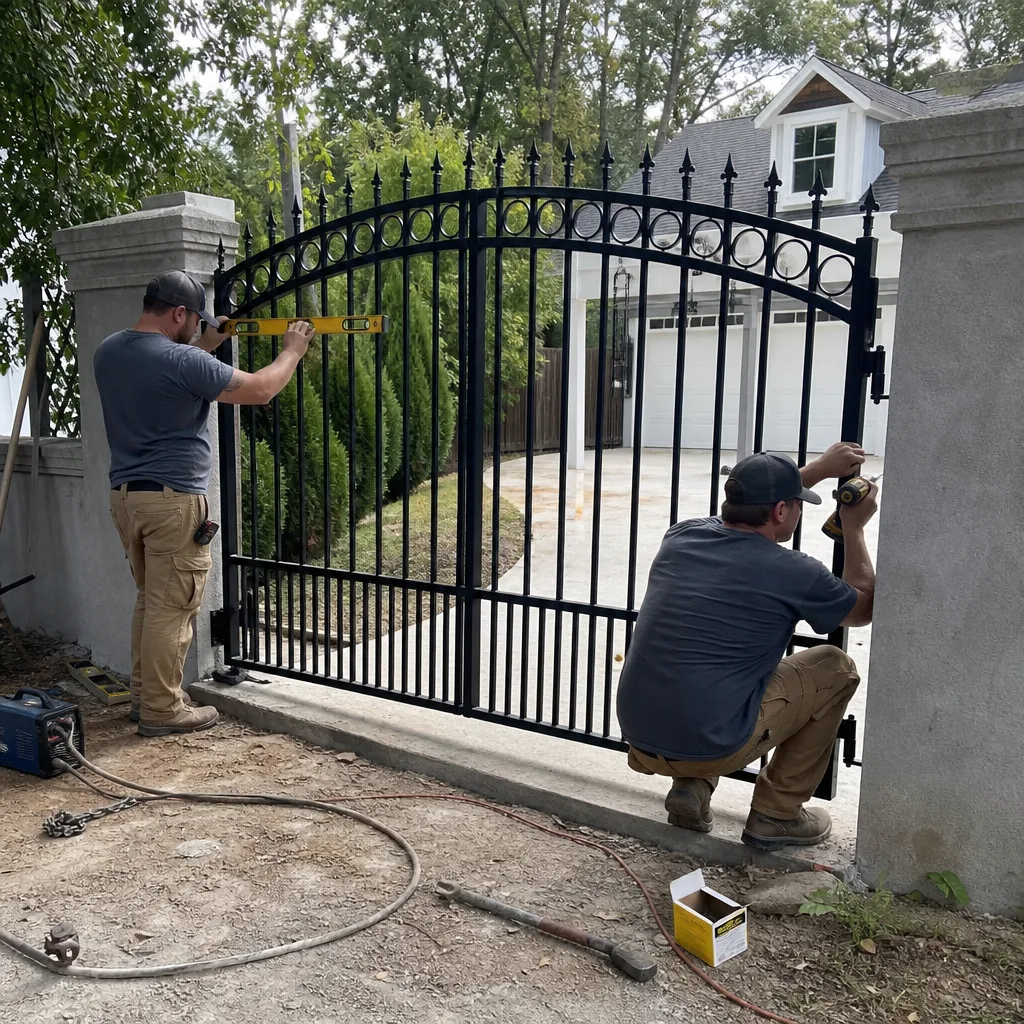
Most residential gate repairs in Alpharetta range from $180 for a limit switch adjustment or photo-eye realignment to $850 for control board replacement with full configuration and testing. Motor replacement on a swing gate typically runs $850-1,600 depending on brand and whether the arm bracket needs replacement. Every price is written and agreed before work starts. Call (678) 679-2152 for a free estimate.
You can safely replace the battery, clean and align photo-eyes, program remotes, and remove physical obstructions. Any repair involving limit switches, control boards, motor replacement, or wiring should be handled by a professional because misdiagnosis creates injury risk or code violations. If you’re unsure which category your problem falls into, a written professional diagnosis costs nothing and gives you accurate information.
Adjusting force settings to override safety reversals is the most dangerous, because it removes protection against crushing injury. Limit switch adjustment is second, because over-travel can cause the gate arm to strike vehicles or people. Structural welding without verifying dynamic load effects is third, because weight changes can cause false obstruction detection or operator overload. All three have caused documented injuries in our service records.
Maintenance repairs to existing installations typically don’t require permits. New electrical circuits, underground wiring modifications, or changes to the grounding system do require permits under Georgia’s adopted NEC. If your repair extends, replaces, or modifies how power reaches the operator, consult a professional or contact Alpharetta’s Community Development department before proceeding. Unpermitted electrical work can complicate insurance claims and home sales.
The photo-eye was likely not the root cause. Persistent reversal after photo-eye cleaning usually indicates increased motor current draw from a binding hinge, failing bearing, or gate that’s out of plumb. The operator correctly interprets this as an obstruction. Increasing force settings to compensate overrides the safety system and risks injury or structural damage. A current-draw test identifies the actual cause.
At minimum: a written scope of work with flat pricing agreed before work starts, and a record of what was done. Under The Haven Standard, Vance Gate Repair Alpharetta provides both plus photographed evidence of every adjustment, part number installed, and limit-switch or torque setting recorded. You receive a copy; we file a copy. No future technician has to rediscover what we already found.
The Bottom Line
The DIY versus professional question isn’t about your skill level. It’s about which failures are safe to make. Battery replacement fails safely. Limit switch misadjustment doesn’t. The line is specific and knowable, and this guide has drawn it where the physics and the code draw it, not where marketing convenience would place it.
In Alpharetta’s market, where gate automation is standard on homes above a certain price point and the service industry varies widely in documentation quality, the homeowner’s best protection is information: a written diagnosis, a flat price, and a record of what was found. Whether you repair yourself or hire, start with knowing what you’re actually fixing. The cost of guessing is usually higher than the cost of finding out.
Written by Adrian Vance, Owner at Vance Gate Repair Alpharetta, serving Alpharetta since 2014.